
Risk Isn't A 4-Letter Word
Sep 30, 2026
Are DAFs one-talent burial grounds?
Old language seldom releases new outcomes. In the world of faith-based investing, is the language we use holding us back from a breakthrough that is bubbling below the surface but not yet a stream from the throne of God? When Jesus democratized religion with his world-shaping life and message, he used some old language and added new. He said a wise teacher is like someone who takes out of his treasury something old and adds something new.
Blending the old and new is good for teaching, but not necessarily for operating models -- the way things work. Here Jesus said something different.
“No one pours new wine into old wineskins. If he does, the new wine will burst the skins, the wine will run out and the wineskins will be ruined.”
There are two different root words for the word “new” used in this verse: neos and kainos.
- Neos refers to a fresh batch or quantity or arrival of something that is essentially the same as it has always been. This is the new of “new wine”.
- Kainos refers to something radically different from the way it has always been. It is a new structure, a new material, a new container: this is the new of “new wineskin”.
7 Wealth Manager Phrases that might not yield eternal rewards
Translating this to the world of capital and investing, neos is just another batch of dollars. Kainos is the mechanism for how the dollars get to their intended destination. It is the latter that must constantly evolve. A problem, as I see it, is that we are using a stagnant money management mantra and hoping to get transformative results. Worse than this, we sometimes obfuscate things with words that hide the real intent. Let's look at some of the language.
|
When we say … |
Perhaps we mean… |
|
Mitigate liability |
My profession prevents me from going out on a limb, so I'd better stop my clients from going out on a limb. |
|
Fiduciary responsibility |
I must make sure that assets under management keep growing. Otherwise, they could be out of money, and I could be out of a job. |
|
Prudent recommendations, balanced portfolio |
Too scared to make an edgy recommendation - see liability above. |
|
Industry hurdle rates |
I can put the investment on autopilot in a US index fund rather than try to do due diligence on a fund manager in Timbuktu |
|
Preservation of principal |
An unwritten rule that capital never gets smaller —obedience, risk or eternal rewards do not trump this “rule.” |
|
First-loss capital |
Someone else's faith absorbs the risk so mine doesn't have to. “Yes, we make impact investments, but come back to me once you have your first investor.” |
|
Derisk |
Remove faith from the investment decision. |
Can we have a new wine skin without new language?
Operating models or wine skins are designed to continuously adapt. Truth is eternal. The method of delivering the truth should not be cast in stone. Similarly, money is designed to flow. The mechanisms that manage money should be steering it in the most fluid way to the places that God intended. How can we adapt our language so that we do not get trapped in an old wine skin? Even if the wine skin is not old, is it fit for purpose? Since a purpose of money is to give Jesus a good return on investment, have we adapted our wealth management mechanisms to accomplish this purpose?
What new terminology would you like to see in the language of faith-driven investing? If you are a wealth manager or financial advisor, what words would you hope could be downplayed in your lexicon? Are there new words or phrases you would add?
|
Could we celebrate … |
And emphasize less… |
|
Flow-through |
Grow the asset base |
|
Faithful through risking |
De-risking, capital preservation |
|
Sacrificial investment |
Solid, sure returns |
|
Opportunity to be obedient |
Guaranteed return |
|
Finding good soil |
Minimizing exposure to frontier markets |
|
Capital deliberately risked |
Capital preserved for future generations |
|
Multi-generational investee growth |
Exits |
|
Balancing temporal and eternal portfolios |
Balanced portfolios on earth with little eternal consideration |
The Apostle James said, "Faith without works is dead." I would say, "Capital without risk is dead."
When Jesus walked past the leafy-green fig tree and didn't find fruit, he announced its death. Capital that is not fruitful in a manner and place that God intends might look good on a Balance Sheet or in an Assets Under Management column, but, for all intents and purposes, it is dead.
I do not envy the wealth manager sitting across the table from Mrs Jones estimating how much money she needs for her remaining years. It must be hard being an advisor who has an eye on eternity but the metrics of today as the yardstick in front of them.
Is this really a new situation?
I heard a story more than forty years ago about two churches somewhere in Europe. I cannot remember the city, and I am no longer certain of the number, so I will not pretend otherwise. What I do remember is the picture.
There was a magnificent old church building, centuries old, beautifully built and richly adorned. A plaque on the building commemorated its long history, permanence and everything that generations had gathered and preserved. Nearby stood a much smaller church with a plaque commemorating the hundreds of people who had been sent out from that small church “into the harvest field.” My memory says there were around 300. What I remember most clearly is not the number but the contrast.
One building seemed to say, "Look at what we have stored up." The other seemed to say, "Look at what we have sent."
I have never forgotten that picture, and I believe it gives us a useful way to think about capital.
We celebrate the size of the asset base. We measure what we have accumulated, what we have preserved and what we have protected, and those things have their place. But money was never designed to sit still. Capital is meant to flow just as people are meant to go.
So, the question is not only how much has been entrusted to us but how we have flowed it through us, where it is going, whether it is producing fruit, and whether it is achieving the purposes God intends.
The better measure of a portfolio is not its size but its fluidity and fruitfulness. It is not how much we have gathered but how much we have deployed, not to a DAF or fund or foundation, but through that plumbing to the point of obedience.
That is the challenge of faith-driven investing: not simply to grow capital, but to put capital deliberately at risk for something that matters eternally. As I said earlier, capital without risk is dead.
Can we have conversations that change the language shaping the flow of capital towards what God intends? He is the God of AND. He is the God of Sunday and Monday. He is the God of my spiritual life and my financial life. He said we are to advance the kingdom simultaneously "in Jerusalem AND Judea AND Samaria AND the ends of the earth." Similarly, I believe we can and should at the same time invest for today AND for eternity. What language, key performance indicators, measures, and metrics would you change or introduce to help us have this today and eternity focus?
Cleverly confused
In another blog post I wrote, “Undeployed capital is most at risk of not producing an eternal return.” If a heavenly audit team analyzed the nearly $1.5 trillion sitting in donor-advised funds, how much would be deemed to be undeployed capital? Is it a half, a third, or two-thirds? Is the portion that is not moving stagnant? Is it a buried talent? And have we forgotten the purpose of money?
In my book, Repurposing Capital: A Return to Faith-Based Finance (Indaba Publishing, 2010) I took aim at those who build a case for hoarding capital under the pretext that the nature of finances changed dramatically.
There are some who contend that the modern views of currency have changed quite dramatically from the intended use of money as defined in ancient texts. Today money is called “currency” in part because it is meant to flow, rather than be stored. Back then, they argue, excess money may have been just stashed under a bed because there was nothing better to do with it. I do not agree with this: when financial principles were given to Israel before they entered the Promised Land, many forms of giving were instituted. It led to a culture of generosity, the building of relationships, a systematic care for the economically disadvantaged, and the growth of capital, all while depending on God to provide miraculously.
Whether the nature of money has changed over time is not as important as whether the perceived purpose of money has changed. Clearly the nature of finance has changed, and the increased sophistication of international financial markets is beyond question. In order to appreciate the faith-based position, however, one has to consider the differences between the generally accepted view of money and the faith perspective. I often ask groups to tell me the purpose of money. The answers range from the standard fare to deep insights.
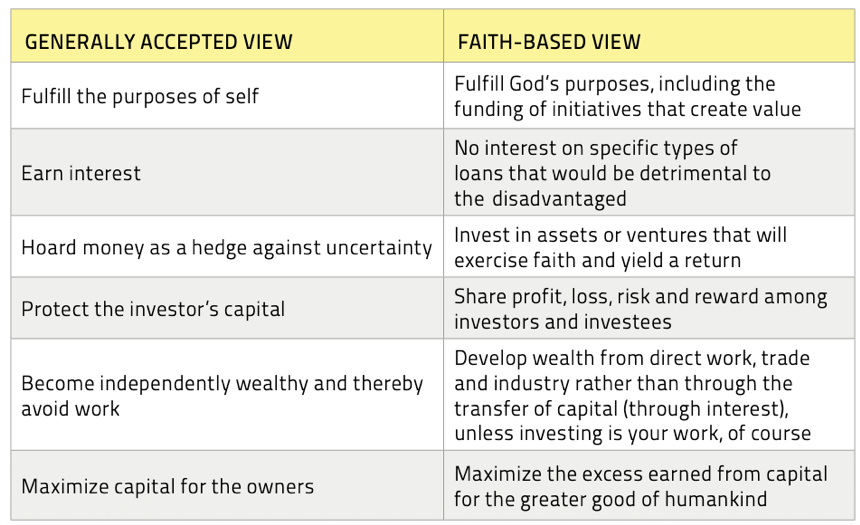
Clever financial terminology does not absolve us from heavenly responsibility. The fact that we have created a category such as Donor Advised Funds does not mean that the funds are allowed to accumulate there and not be risked for eternal purposes. I worry that the government will step in to correct our unintended hoarding if we do not practice wise self-regulation.
Closing questions
Here are some of the questions going through my mind:
- We easily age Receivables: why don't we age money sitting in DAFs?
- Could we set flow-through targets where we agree on percentages that need to move within 6 months, 12 months, and 18 months?
- What if (pick a number) 50% of capital got invested in value-creating work? In other words, it went into the righteous cycle of work and not financial instruments, indexed funds, money de-risking already derisked money?
- Could we pre-agree on fair returns for investors and inventors and dedicate any excess to an evergreen fund? (That way, if God gives an extraordinary return, the money is contractually His.)
- If we were serious about the Great Commission, would we not create a blended fund for sphere transformation? This way, teams seeking to transform healthcare, media, capital, law, etc. will have a war chest.
- Again, if we were to pay more than lip service to the Great Commission, would we not create a fund for city transformation? Would we not dedicate capital towards transforming the systems and cities of our world instead of just the people?
- This would be cosmos-level investing, not just ethnos and eschatos (about which I have written in Investing with Africa)
While I'm busy stirring the proverbial pot, I'll pose one more question.
- Can we stop hiding behind the pretext of “no one is doing anything risky enough or big enough—that’s what stops us investing large sums”?
I heard this story more than 25 years ago in Silicon Valley and found it to be a convenient excuse that masked a condition of the heart. Then, overnight, the dot-com crash happened, and billions of dollars disappeared from the net worth of Christians. Are we not at another Kairos moment in history when new levels of wealth should be funneled through new wine skins (kainos) to empower completion of an old mandate? The generations of Christ followers alive today may well be weighed in the balance based on how we respond to these times.
Email me if you would like to participate in these types of conversations.
Brett Johnson
Author
